Tempodrom sold, Berlin pays extra

In today’s online issue the Berlin newspaper Tagesspiegel confirms previous rumors: the Tempodrom is sold, the compulsory auction of the venue near Anhalter Bahnhof scheduled for today is canceled: “The Bremen based business group KPS has bought the venue Tempodrom in Kreuzberg.” [tagesspiegel.de]

Basically this should be good news for all parties involved – if only the city of Berlin would not lose a lot of money on this deal. What went wrong? First the construction of the Tempodrom turned out to be way more expensive, than originally calculated. With bankruptcy and insolvency around the corner Berlin guaranteed financial security of various credits, that now turned out to be bad loans. The real financial value of the building is estimated around 3 million Euros, original construction costs were about ten times higher. During the last years the city of Berlin signed financial guarantees summing up aroun ‘several million’ – the exact amount of money that Berlin now has to pay currently remains unclear.

Now let’s have a look at the possible future of the Tempodrom: as already stated the venue with the spectacular architecture is now owned by Bremen based KPS – also known as  “KPS Concertbüro GmbH”. KPS is a concert organizer, who originally operated mainly in the North of Germany in the geographical area around Bremen, Hamburg and Hannover. Nowadays KPS also owns the Berliner summer venue Waldbühne and the online ticket shopping portal “eventim”.  With the Tempodrom KPS now has a acquire a live venue, that would enable KPS also in winter months to host concerts in Berlin – and therefor might be seen as a bad weather pendant to Waldbühne. Congratulations!

please feel free to check the original german article over here:
–> www.tagesspiegel.de/berlin/Tempodrom-Kreuzberg…
Berlin S-Bahn services not back to normal before 2013

What is normal – and what’s not? Berlin newspaper Tagesspiegel (www.tagesspiegel.de) today reports that the trains of Berlin’s popular public transport system ‘S-Bahn’ will not be back to normal operation for the next three to four years. So at least for the next three to four years the current ‘state of emergency’ will probably be ‘normal’.

What happened? After a series of breakdowns S-Bahn owner “Deutsche Bahn” had to call most of the trains in for reparation. Listing the problematic parts feels stupid since almost all parts seems to be affected in one way or the other: after some breakdowns first the trains’ wheels had to be checked. Later it became clear that also the breaks, the electrical systems and even the doors were not maintained properly for quite a while. Additionally some of the precious train cars broke down due to problems with the wintery temperatures Berlin faced early December.

The reasons for the neglectings seem to lie in the privatisation ambitions of S-Bahn owner Deutsche Bahn: the company recently wanted to go public – and it seems as if therefore money was sucked from Berlin S-Bahn – by not properly maintaining the trains, rails and cars. Not the city – or actually the people pay the price for this money Deutsche Bahn saved over the past years.

As a consequence some people demand that the Berlin S-Bahn should be owned and operated by the city of Berlin – and actually the city of Berlin now even seems to consider buying the S-Bahn from its current owner Deutsche Bahn. But if Deutsche Bahn actually also considers selling might be quite a different question.

BVG: public transport strike -and Easter

It looks as if the Berlin public transport strike was over – and actually Trams, Busses and Subways are back on track – for now.. And it is actually half-way true: this week the Tram-, Bus- and Subway-Drivers quit striking and after almost two weeks finally began to work again. But beware: just before Easter the BVG-workshops quit working. Instead of 600 there’s now only around 30 people taking care of the cars.. – ..and that means thatthere might be less vehicles in operation. Yesterday the number of BVG-busses working was already down to 80% – which basically means one out of five is down.

For Easter the workers union ‘promissed’ that everything would be back to ‘normal’ – but there might still be irregularities and delays on some lines..

..and what will the public transport situation be after the Easter Weekend..? ..probably -back-to-normal- …which could mean -back-to-strike-.. – ..we’ll soon find out..:]

BVG: public transport strike

Already yesterday most of Berlin’s public tranport system BVG went on strike – or actually of course the workers of the BVG went on strike – not the public tranport system itself. Anyways. The timing for this ‘biggest strike ever’ was quite perfect: snowy weather took the traffic problems to the next level..
Anyways – what does that mean? ..how can you still get from A to B..?

The good news is, that currently ‘only’ the BVG went on strike – that means that ‘only’ all the U-Bahns (subway), all the Trams (streetcars) and almost all busses are out of order for an unlimited time span – but the city trains “S-Bahn” are still running, and also the local trains and some 100 private busses are in operation.
The bad news is, that from Monday on this might be a hole different game, since now also the union of the City-Train drivers and train drivers asked their people to go on strike from next Monday on.

And then what..? Well – in Berlin there’s always another option – here’s three possible alternatives: first of all taking a TAXI (cab) for example is still quite affordable in Berlin. Second: thanks to the geographical flatness of the city riding a bicycle can still be quite relaxing – and you’ll discover streets and corners that you’ll never had a chance to see taking the U-Bahn. Third option: walk! ..seriously: I love walking – and a friend of mine even used to walk from Friedrichshain to Tiergarten twice a week! You’ll discover even more streets and corners and meet people and and and..:]

..greetz, t..

free wireless internet for Berlin

..at least that seems to be the vague idea of Michael Müller, head of Berlin’s social democrats party SPD.

So far it is not clear if this wireless web access would grant full range free access to ‘the real web’ – or just some kind of ‘city web’. The city of Heidelberg at least offers such a reduced free-but-not-open web access solution, mainly ment to be used by tourists (see also the related article at Spiegel online (german))..

Of course instead I would warmly recommend a free municipal WiFi access solution to the ‘real web’ for Berlin – with full access to the internet, full email functionality, but maybe with some kind of bandwidth limiter installed so that misusing the free web slowing down the overall speed for everybody by uploading or downloading movies or other large files.. – ..but otherwise in my opinion the web should be freely accessible for everybody – everywhere.

I know there are various good examples of working open city access points – one good example can be found in the European neighbourhood: The Finnish capital Helsinki offers open access points already since 2006 (see also the related article at Helsingin Sanomat Newspaper) – first public libraries and offices opened up their wlan base stations, later some additional 70 stations were installed, today even public transport vehicles (buses and trams) offer free access points to their passengers (see also the related article at Helsingin Sanomat Newspaper) so that today a large area of helsinki’s city centre is covered by the city’s free internet access.

The biggest problem might actually be, that in Berlin things are usually not really decided quickly – and so it might be, that there will be alternatives growing quicker than the well discussed Master Plan. One of the most promissing alternatives I see is Berlins density of bars and cafés (see also  cafespots.de/wlan-hotspots/berlin for an (incomplete) overview). Quite many are already offering free wireless internet access – and i am quite optimistic that this trend will continue to grow and soon will cover most of the ‘interesting areas’ anyways – regardless to whatever the city council may come up with – or not..

S-Bahn – city train strike

Starting this post I first have to mention some translation curiosities I stumbled upon: I first could not really believe that the English word for ‘Streik’ is ’strike’ – but that’s what my online dictionary suggested.. Well. Then I was wondering how I could translate the name of the German railway company – a word-by-word translation of “Deutsche Bahn” would result in “German Train” or “German Rails” – but maybe it’s not a good idea to translate names anyways..

Anyways – back to the topic: the Description-Tag of the homepage of the Berlin city train company “S-Bahn” (www.s-bahn-berlin.de) says it quite clearly: The ‘S-Bahn Berlin GmbH’ is a company of the Deutsche Bahn Group – and is not part of the Berlin public transport company BVG. And this is the very reason why last weekend not only the train traffic was affected by the strike of the train drivers – but also the Berlin public transport system was quite heavily affected. In other words: also the Berlin S-Bahn- / City-Train drivers went on strike.

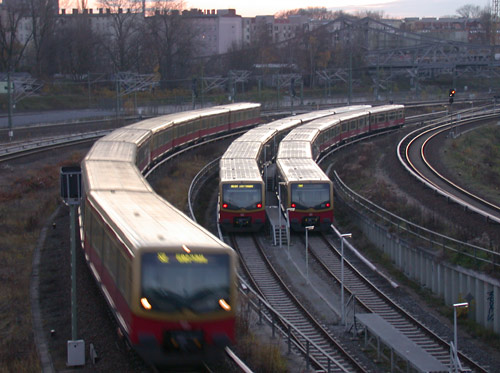
This is also the reason why one could spot ‘parked’ city trains here and there – on the photo below you can see parked city trains I spotted from the bridge ‘Behmstraßenbrücke’ between Wedding and Prenzlauer Berg..

S-Bahn - City-Trains Berlin

Berlin S-Bahn trains – Photo: T.Bortels/nuberlin.com

Looking at that picture one could think that two out of three trains were not in operation – but of course that wasn’t the case. I actually have no idea how many trains went – or not – in the news it was said that some lines were only served every twenty minutes, other lines only every fourty minuted – some lines even worse – looking at the reactions from different blogs I get the impression that this ‘largest ever train strike’ was quite ‘effective’ – or ‘effectful’..? Well..

We’ll soon see if this strike actually leads to talks and/or a solution – otherwise the next strike might be just around the corner…

..greetings, t..

Redesigning Oderberger Street

You could read it on Flyers attached to trees, glued to street lamps, pinned to doors – and also the black stripes (not a band) hanging from trees and bushes in the Oderberger Street made it quite clear: the Oderberger Street (Berlin Prenzlauer Berg) is about to be reshaped’, rebrushed’, ‘redesigned’.

Oderberger Street Green - Prenzlauer Berg

Green in Oderberger Street, Prenzlauer Berg

The city council’s motivation for this ‘redesign’ is probably mainly to remove all the trees, bushes and the ‘green’ that was originally planted ‘wildly’ by the residents of this neighborhood since the late 80ies – on the other hand this ‘wild green’ is probably one of the reasons why the Street is so well known and often considered ‘beautiful’ – or at least ‘different’ – one of the features that makes the Oderberger Street stand out from the crowd unique.

Some thoughts about the possible reasons for this ‘redesign’: as far as I know every tree and every bush that grows on Berlin soil has its very own identification number – and is registered, catalogued and managed as professionally as possible. But how do you manage some ‘green’ if you can’t even tell if it’s a tree or a bush..? So the easiest solution to that problem seems to be to take action under the headline ’safety first’ (there’s rumors that some people have complained about the bad condition of Oderberger Street and that it is almost impossible to walk on the pavement with kids and/or a pram and/or a wheel chair and/or high heels – and that additionally also the cars were suffering from the view covering ‘dangerous’ green hanging everywhere) and ‘redesign’ the street.. which currently seems to mean taking down everything green that is neither registered nor catalogued.
see also:
Citizens’ Initiative Oderberger Street (BIOS) -> www.oderberger.org
article ‘the green spirit of the Oderberger’ (TAZ (german))
plans/maps (PDF) of the panned ‘redesign’ of Oderberger Street
• and a blog post (german): Jenz Steiner: ‘too green for the greens’

green greetings, t..

PS1: my personal opinion about this ‘redesign’: make it a ‘playground street’! There’s enough good examples of The local birth rate – actually the local concentration of children per square meter is quite high and sooner or later the kids might (re)claim the street anyways. If it was a ‘playground street’ it would be perfectly safe to walk down Oderberger Street on high heels with kids playing football and a pram and a wheel chair – or simply in the a row of four people next to each other..!

PS2: some more pictures of Oderberger Street and Kastanienalle can also be found from my ‘photo-blog’ at bilderbook.org/berlin..